
For many communities, the process of language revitalization begins in an archive with handwritten notes, old dictionaries, and recordings. But how are these materials transformed into lessons, apps, and resources for a new generation of learners?
At National Breath of Life (BoL), participants use the National Breath of Life Training Trajectory, a dedicated model for this work. This process is a continuous cycle designed to guide languages from archives to learners by turning historical data into living knowledge.
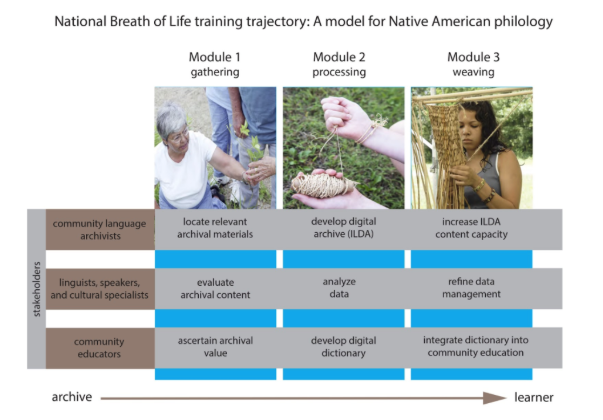
The process is built on three interconnected phases:
1. Gathering: Archival Development
This is where the work begins. In the “gathering” phase, community researchers locate and digitize archival materials. This hands-on work often involves traveling to archives across North America to find and scan digital images of archival documents containing language or cultural information.
2. Processing: Transcription, Analysis & Interpretation
These historical documents are often messy, faded, and difficult to read, so community researchers carefully type each word exactly as it appears in the original record. This transcription turns the messy script into a clear, digital text that is ready to be analyzed.
The scans and their transcriptions can then be uploaded to the Indigenous Languages Digital Archive (ILDA) for community researchers to analyze. They study the transcribed records, sentence structures, and interpret meanings in a modern context.
The result of this work is the ability to add words and phrases with their translations to ILDA, turning static historical entries into a usable, searchable database for language learning communities.
A great example of this process in action is the work the Miami Tribe of Oklahoma has done with the Pinet Dictionary. This large document from the 1690s has been systematically transcribed and analyzed to build a digital repository of words and phrases, making the information accessible for the next phase of work.
3. Weaving: Education & Distribution
This final phase is where the processed language data is “woven” back into the community. Through curriculum development and work by language instructors, the analyzed language data is transformed into engaging lessons and tools.
The goal of this phase is to create resources that are ready for community programs and self-directed learning. This is how an archival entry from a centuries-old document can become part of a language-learning app, a children’s book, or a community language class, ultimately reaching learners in the community.
A Continuous Cycle
This process is iterative, cyclical, and the work is never truly done. New analysis can lead back to the archives, and new learners can inspire the creation of a new curriculum. It is a living, breathing process.

At National Breath of Life, our mission is to guide participants through each step of this cycle. From the archival development phase to analysis and distribution, we provide the training and individualized support to navigate this path. This collaborative work is how we move from a silent entry in an archive to the vibrant sounds of languages being spoken in their communities, ensuring they are heard for generations to come.
 National Breath of Life Blog