
National Breath of Life apprentices traveled to Miami University in Oxford, Ohio on May 2-4, 2024 to participate in the first-ever apprenticeship gathering. The gathering, supported in part by the Myaamia Center, the National Endowment for the Humanities, and the Mellon Foundation, allowed participants to meet face-to-face to learn from one another, share experiences, and facilitate community.
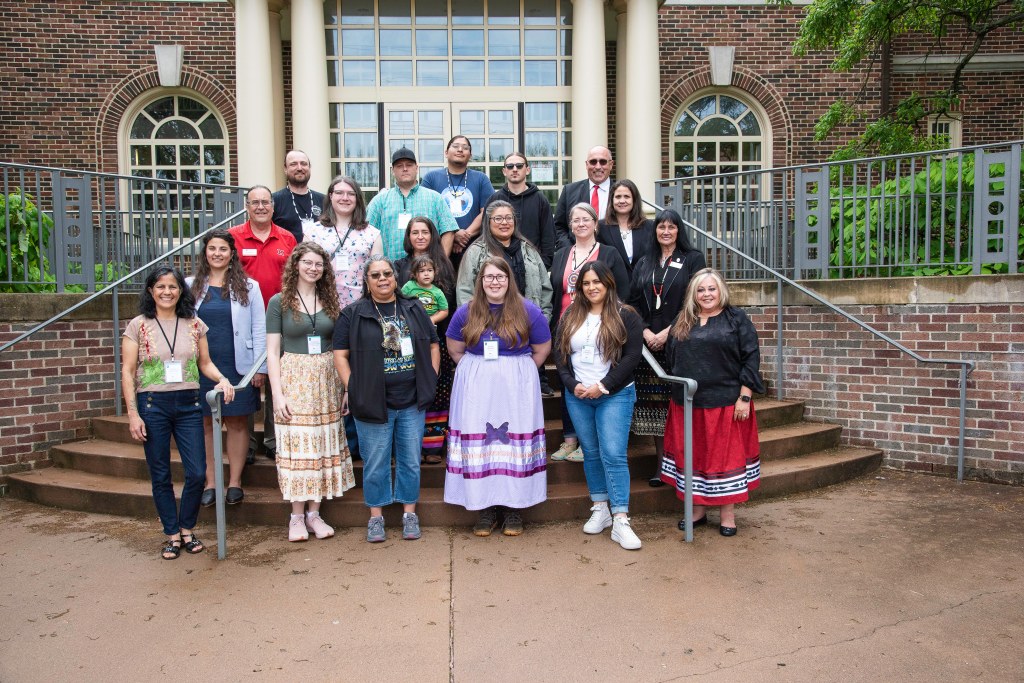
The National Breath of Life (BoL) Apprenticeship Program, launched in 2022, currently trains 13 apprentices, identified by community language leaders, from 10 tribal communities. The apprentices work with community mentors and the National BoL archives development trainer to increase language database capacity, refine data management, and integrate an ILDA dictionary into community programming.
Archives-based language research for revitalization can be as challenging as it is rewarding. Archival documents must be organized and transcribed before digitizing and being evaluated for cultural information. Dictionaries can be developed and language taught to community members only after this process is complete. As an emerging field, archives-based language researchers often struggle to find support, tools, and peers who are equally engaged in this work.
While National BoL offers virtual gathering opportunities monthly, our program directors have learned from previous workshops that in-person meetings are invaluable for building community and sharing experiences or strategies.

Programming began on the morning of May 2, as Dr. Gabriela Pérez Báez and Daryl Baldwin, National BoL co-directors, welcomed 11 apprentices from 10 tribal nations to the gathering. Miami Tribe of Oklahoma leadership, Miami Tribe staff, Myaamia Center staff, and other guests were also in attendance.
On the first day, apprentices presented and engaged in lively group discussions about their work with dictionary development, before Jarrid Baldwin, Myaamia language coordinator at the Myaamia Center, presented his work with the Miami Tribe’s Educational Programs. Jarrid explained how he shares knowledge by incorporating language into community programming.
After lunch, sessions focused on utilizing language as a source of cultural information. Apprentices shared how their work with archival materials has reconnected their communities with the cultural information that language contains. To conclude the day, Dr. Haley Shea, Director of the Myaamia Center’s Office of Assessment and Evaluation, presented her work with Nahi Meetohseeniweenki, the ‘Myaamia living well’ model, and how language informed this research.

The second day of the gathering focused on reflection and future development. The morning began with a group discussion encouraging apprentices to share feedback on the program. During this discussion, apprentices also shared their projects’ next steps. Discussions like these allow our staff to better understand each community’s unique needs and provide better programmatic support.
Dr. Doug Troy and his team of Miami University graduate student software developers met with participants in the afternoon to discuss ongoing improvements to the ILDA software suite and better understand how the software is used in tribal communities.

While the gathering officially ended on Friday, May 3rd, National BoL participants were invited to stay on Saturday to attend the 10th biennial Myaamiaki Conference. Attending the conference allowed apprentices to learn how the Myaamia Center, the institutional home of National BoL, supports Myaamia language and cultural revitalization.
While National BoL has presented at this conference before, we were excited to do something different this year, by inviting apprentices to speak about their experiences in a panel discussion. The panelists spoke about the language materials they work with and some highlights of the program. Highlights included using ILDA software to share language materials, receiving support and inspiration from peers and mentors, and finding personal connections to culture, language, or history in the archives.

For those interested in watching the panel discussion, it is now available on the Myaamia Center’s YouTube channel.
As an organization working with participants from many different geographic locations, communities, and cultural backgrounds, we recognize the importance of providing opportunities to build a network of support in this field. This intertribal network only strengthens archives-based language research for revitalization by allowing researchers to address any barriers as a collective. After the 3-day apprentice gathering experience, we hope our participants left feeling excited about the endless possibilities to advance language and cultural knowledge through archival materials.
 National Breath of Life Blog
One Comment Add yours